The Guiding Principles Governing Our Communication Network
© 1999 Michele Toomey, PhD
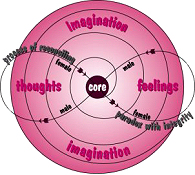
Today's technology is giving us the opportunity to see how the brain receives and sends messages throughout our system. Lest we had any doubt that emotions have any impact on us, we can now see in living color what happens when we are excited, afraid, angry or the like. We can also measure the speed and amount of energy it takes to transmit and process information depending if it's difficult or easy for us, if it's new to us, and if it upsets or excites us. In other words, for the doubters who wanted to think that we are computerized brains that only think and analyze and calculate, we have proof that the way we experience something affects the way we relate to it, and the way we relate to it affects the way it is communicated within our system, both in its transmission and in its reception.
Liberation psychology teaches that the principles governing this communication network within us are designed to preserve the integrity of the system. What that means is that when we participate in this system we need to be in accord with our nature not in control of it. This is tricky, because in the tradition of the western world, nature is to be controlled and conquered. Consequently, as we learn the psychology of how to use the information that is transmitted and received by us and in us, we need to learn a way that's counter to our tradition. Rather than try to control the data and our relationship to it, we need to learn to process it and relate to it with fairness and respect.
When we receive a message, our first response to it is an automatic reaction. If, for instance, we cut our finger, the message of pain triggers a reaction. We don't have to tell ourselves, "I should feel pain", we just do. This automatic reaction is the "nature" of the system, universally, but, after that it becomes individually determined. There are cultures that teach their people to learn not to react to the pain until they don't feel the pain, and they are going "against" nature. These are learned responses to pain that childhood experiences have taught us. If a boy is brought up to never cry when he feels pain, his reaction to pain will be different from a girl who is encouraged to express her feelings when she's hurt.
The lesson here, is that by nature physical pain triggers a reaction of pain and to live in accord with our nature we need to allow ourselves to feel it. How we deal with the feelings after we've received the initial message is a learned response. Liberation psychology teaches that we need to be true to the feelings and express them with integrity, fairness and respect. Often, if the response is allowed, we may have learned to blame others for our pain and instead of dealing with it we attack another for it. That is abusive and we are out of line in that response. We should be confronted when we attack instead of express, and that behavior should not be tolerated. It is violating another and is not in "accord" with nature response. Accountability is the vehicle that allows us to live in accord with our nature.
The following principles govern self-expression with accountability:
- Integrity, honesty, must govern the way we receive and the way we send messages. This maintains the integrity, wholeness, of our communication system.
- Confrontation that exacts accountability is the vehicle that allows us to maintain our integrity and the integrity of our system and, therefore, allows us to live in accord with our nature.
- Interactions, exchanges of information, with one's self or another must be fair and respectful.
- Thoughts, feelings and imaginings and behavior are all sources of information, and all are equally legitimate and should be taken into consideration and become part of the discovery process.
- The exchange is designed for discovering new information and should lead to greater understanding and caring.
- Greater understanding allows for intimacy to occur and the vulnerability of intimacy must be treated with respect and care.
- Vulnerability is not a sign of weakness but of openness, and openness is valued because it yields intimacy.
- Intimacy is a primary human need as is protection. For intimacy to occur we must be able to trust ourselves and another so that we can allow ourselves to be open and unprotected.
- Intimacy, not conquest, is the goal of an exchange of information.
- Strong negative emotions such as anger need to be expressed as a claiming of the intense feelings without being turned into weapons to attack and blame and therefore abuse one's self or another. Understanding and respect for the negative feelings should yield intimacy not abuse.
- Psychological liberation is the freedom to choose intimacy.
|